Georgia Visits the Dürr Group at Justus-Liebig-Universität Gießen
 Steven Schofield
PhD student Georgia Predila has just returned from a six-week research placement in the group of Professor Michael Dürr at Justus-Liebig-Universität Gießen in Germany.
The placement was funded through the Advanced Characterisation of Materials Centre for Doctoral Training (ACM-CDT), which supports extended visits to external research organisations as a core element of student development. Georgia returns with new practical skills, fresh perspectives on surface science, and connections to an important part of the international community working on atomic-scale modification of semiconductor surfaces.
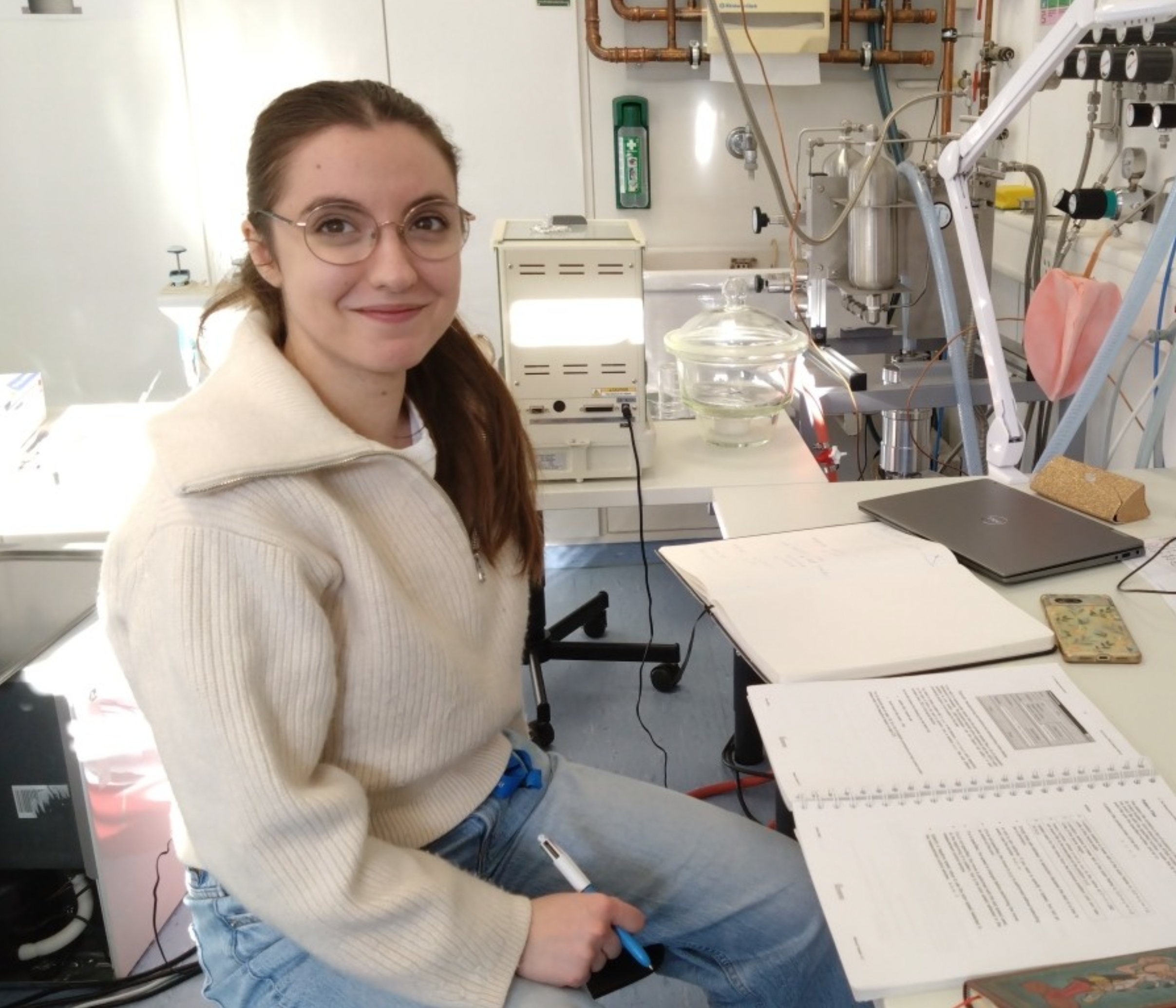
Georgia joined the group to work on the chemical modification of the Ge(001) surface, a system with close structural analogies to Si(001) but with electronic properties better suited to certain quantum device applications. Her main project centres on the creation of arsenic delta-doped layers in germanium. By exposing the clean Ge(001) surface to arsine gas, arsenic atoms are incorporated selectively into the topmost atomic layer of the crystal. Germanium is then grown on top by molecular beam epitaxy, burying the dopants and creating an atomically thin, highly conducting plane within the crystal. These two-dimensional electron systems have significant potential for the realisation of electronic devices at the nanoscale and atomic scale, including quantum computing architectures analogous to those being pursued in silicon. To characterise these structures, Georgia has already taken samples to the PETRA III synchrotron at DESY in Hamburg, where angle-resolved photoemission spectroscopy (ARPES) measurements directly revealed the two-dimensional electronic structure of the buried conducting layers. These are exciting early results, and the analysis is ongoing.
Michael Dürr is one of the leading experts in the organic functionalisation of silicon surfaces, and his group has developed deep expertise in controlling how molecules adsorb, diffuse, and react on Si(001). A visit to his laboratory offered Georgia a natural opportunity to broaden her skill set in a closely related but distinct area of surface chemistry, and to experience a different research environment. During her six weeks in Gießen, Georgia joined one of Michael’s students to begin an investigation of coronene adsorption on silicon. Coronene is a polycyclic aromatic hydrocarbon consisting of seven fused benzene rings and is an attractive building block for bottom-up molecular electronics. The longer-term vision motivating this work is to use the hydrogen-terminated Si(001) surface as a template on which coronene molecules can diffuse and interact, ultimately coupling together to form extended, graphene-like molecular architectures through on-surface synthesis. Such an approach could, in principle, allow the controlled creation of structured organic overlayers with well-defined electronic properties. The initial focus of the project was more foundational: to establish reliable conditions for depositing coronene onto the surface and to characterise the resulting adlayer. Working alongside Michael’s student, Georgia carried out coronene evaporation onto the clean Si(001) surface and obtained some intriguing early results that she is now analysing back in London.
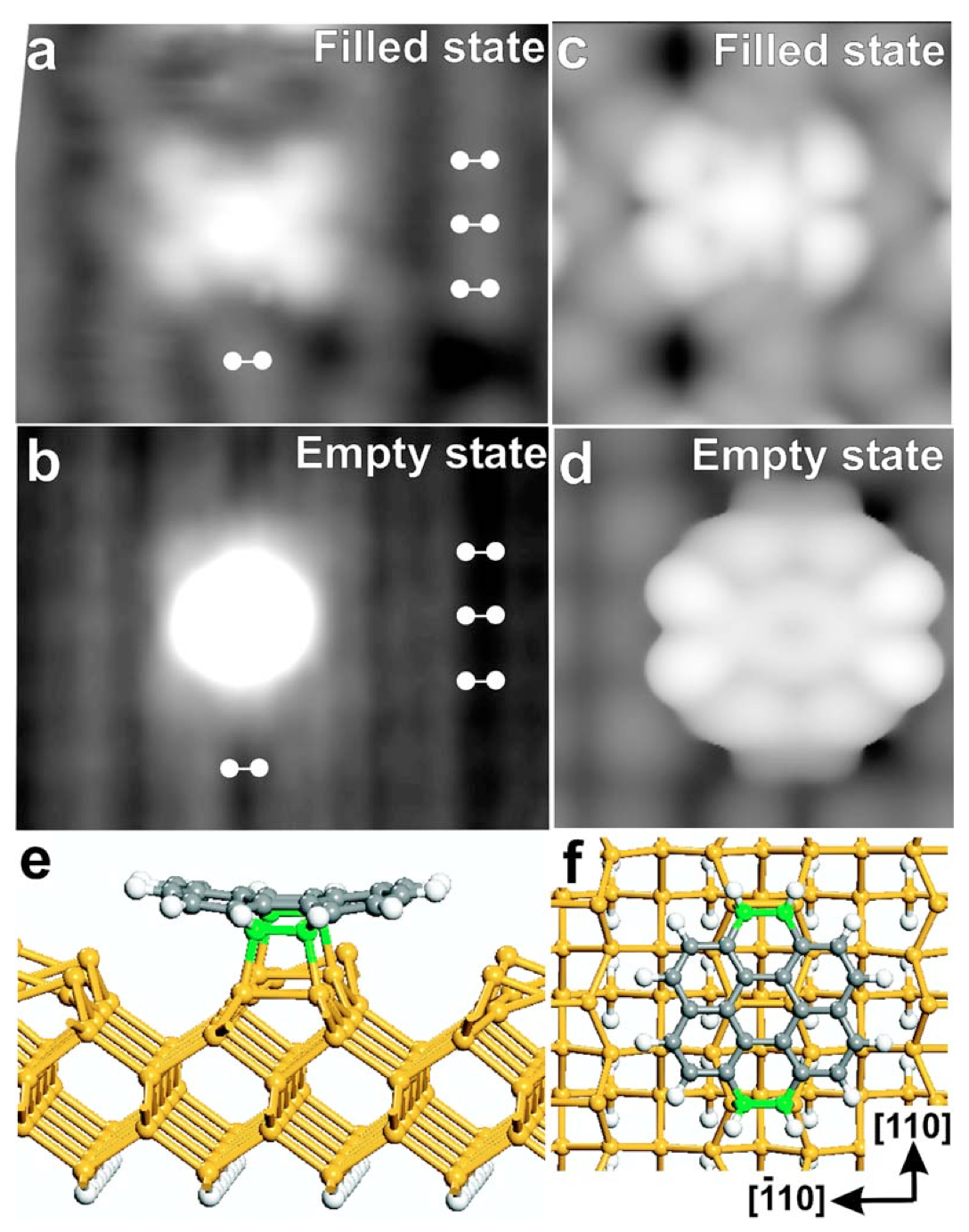
Prior STM studies have already established that coronene chemisorbs on the clean Si(001)-2×1 surface through the formation of covalent Si–C bonds with the underlying dimer rows, with the molecule adopting a slightly buckled, saddle-like geometry in its most common adsorption configuration [Suzuki et al., J. Chem. Phys. 124, 054701 (2006)]. That work identified three distinct adsorption sites and showed that coronene adsorbs randomly at room temperature and does not form two-dimensional islands. Despite this foundation, the detailed adsorption chemistry of coronene on silicon surfaces is not yet fully understood, and there remains considerable scope for new experiments to clarify the role of surface preparation, coverage, and temperature in determining molecular ordering and reactivity.
Extended placements of this kind are something we actively encourage within the group. Six weeks is long enough to contribute meaningfully to a real project, to learn new techniques first hand, and to begin building the kind of professional relationships that often underpin long-term collaborations. For a student still in the early stages of their PhD, the experience of adapting to a different laboratory, with its own equipment, routines, and scientific culture, is itself an invaluable part of research training. We are grateful to Michael and his group for the warm welcome they gave Georgia, and to the ACM-CDT for funding the placement. We look forward to seeing where the coronene project leads and other exciting developments from Michael’s lab, and to continuing to develop connections with groups in the international surface science community.