Geachte Promovendus: A Dutch PhD Defence in Eindhoven and a Visit to Nijmegen
 Steven Schofield
On Monday I was at Eindhoven University of Technology (TU/e) for the PhD examination of Julian Zanon, whose thesis is entitled Multiband continuum theories for coherent charge and spin effects in semiconductors: spinful defects and antimonide superlattices.
Julian was supervised by Michael Flatté at the University of Iowa as his first promotor, and by Paul Koenraad at TU/e as his second. Paul officially retired earlier this year, but returned to Eindhoven for the occasion.
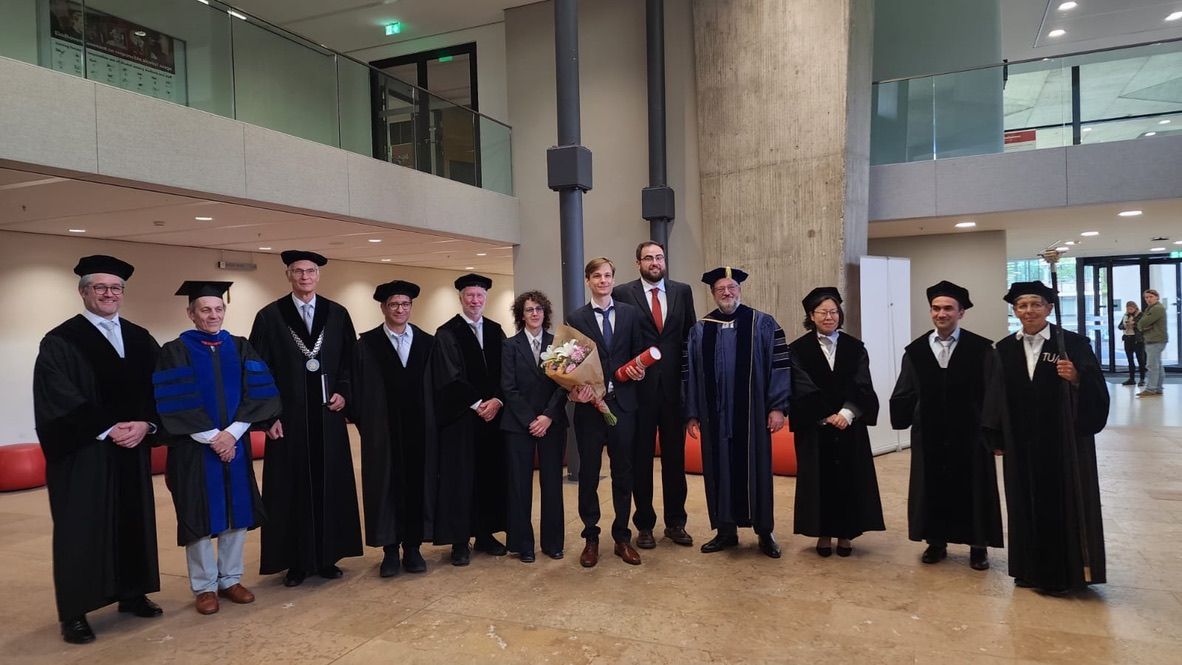
PhD examinations in the Netherlands are considerably more formal than those I am used to in the UK. The examination panel comprised eight members in total, and we all wore full academic dress: gowns and a soft, floppy beret-like cap. The proceedings were strictly ritualised. A ceremonial attendant presides over the room bearing a mace and is responsible for timekeeping; as per tradition, the examination ran for exactly 50 minutes, following a 10-minute presentation from the candidate. At the end of the allotted time, the attendant stamped her mace on the floor and called “Hora est” (the time is), marking the end of the exam. I was allowed 12 minutes for my part of questioning the candidate, and was required to begin my questioning by saying the Dutch words “Geachte Promovendus” (Honoured Candidate). For those of us more used to the rather informal atmosphere of a UK viva, there the weight of tradition attached to the whole occasion is striking. This is very different from how we do this in the UK, where two examiners and the candidate discuss the thesis in a closed room for as long as it takes, typically 2 to 3 hours, with very little formality at all. I found that I enjoyed the formality and ceremony of the Dutch approach while simultaneously wishing I had a little more time to discuss the science with the candidate. Nevertheless, it was a great experience and wonderful to see Julian receive his doctorate with flying colours. All panel members were genuinely impressed with his results.
Julian’s thesis (which can be downloaded here) applies multiband k·p models to four topics: the electronic structure of acceptor states in silicon, spin and magnetic properties of manganese dopants in GaAs, valence band offsets in InAs/InAsSb superlattices, and active region designs for antimonide intercascade lasers. Two of these connected most directly with our own work. The first concerns the application of k·p theory to modelling the anisotropy of acceptor states in silicon. Acceptors – atoms such as boron that substitute into the silicon lattice and bind a hole – produce localised quantum-mechanical wavefunctions whose spatial character is shaped by the underlying band structure. Julian’s work provides a rigorous multiband continuum framework for understanding this anisotropy, drawing on experimental data from our lab for direct comparison with theory. There is something satisfying about seeing your own measurements woven into the theoretical framework of someone else’s thesis. The second theme that aligns closely with our work was the treatment of manganese dopants in GaAs: specifically the spatial structure of the bound acceptor state and its interplay with the local magnetic moment of the Mn ion. GaAs:Mn is a canonical system in dilute magnetic semiconductors and has attracted intense experimental attention over many years, and Julian’s theoretical work sheds new light on the spatial and magnetic structure that underpins its behaviour.
The following day I travelled to Radboud University in Nijmegen to visit the group of Alex Khajetoorians. It was an excellent opportunity to catch up with Alex and hear about the recent directions of his group’s research. His group has moved quite strongly into the study of semiconductor materials, which is a particularly timely development from my own perspective and made for a stimulating set of discussions. It is always valuable to see what a leading group in a neighbouring area is working on, and this visit was no exception.