High School Students from the American School in London Visit the Lab
 Steven Schofield
A group of high school physics students and their teachers from the American School in London visited UCL on 21 May for a seminar on quantum physics and a tour of our Low Temperature Scanning Tunnelling Microscopy laboratory.
The students arrived in the morning and we took them to a lecture theatre in UCL’s Department of Physics and Astronomy, where I gave a thirty-minute seminar introducing the science behind our research: how quantum tunnelling makes it possible to image and manipulate individual atoms on surfaces, and the motivation that drives this work. The talk was recorded and is available to watch here, along with other research talks you can find on our Presentations page.
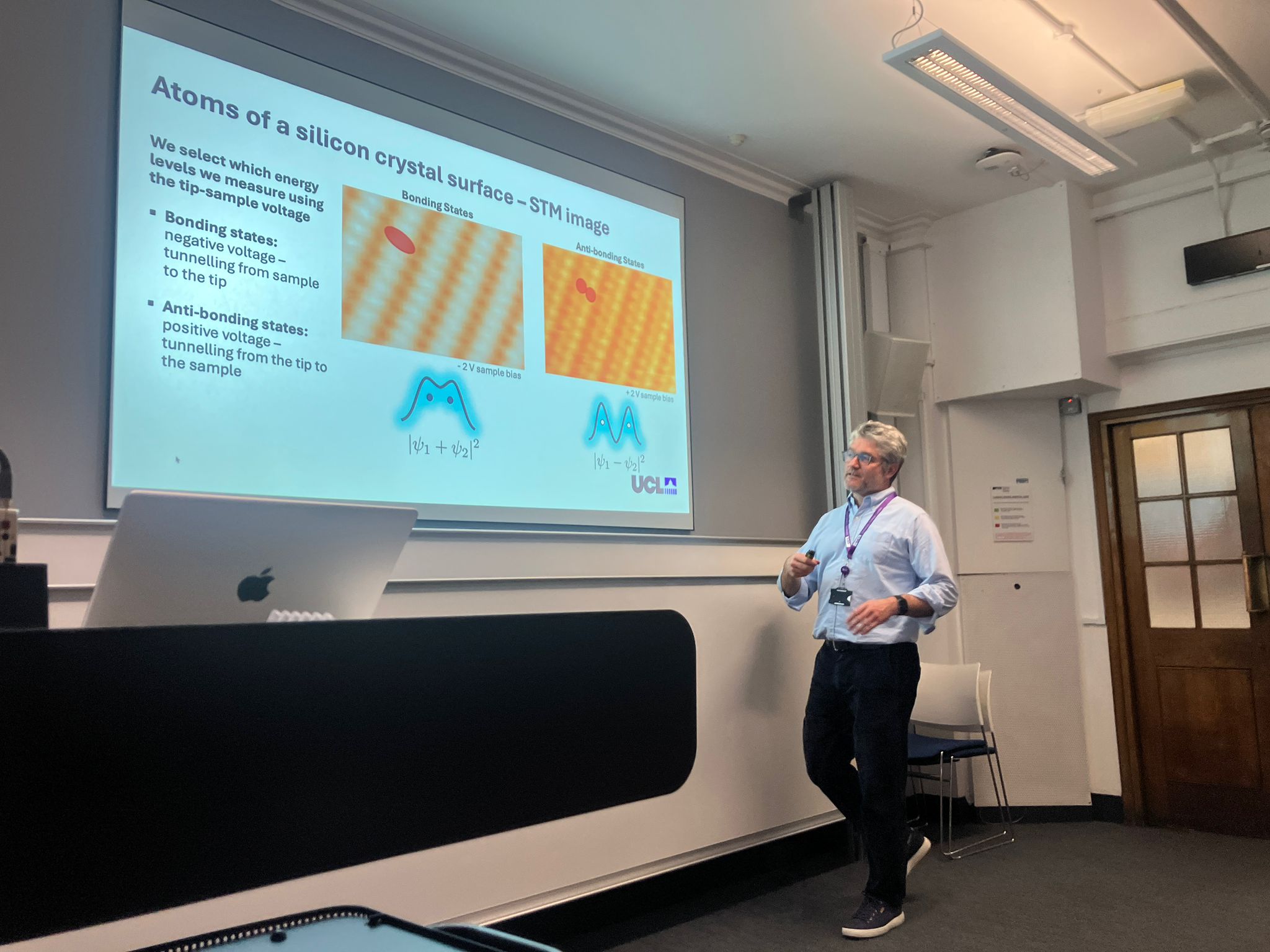
The seminar, Seeing the Quantum World — Electrons, Atoms, and Tunnelling Microscopy, traced a path from the foundations of quantum mechanics to the frontier of atomic-scale imaging of quantum states. It began with wave–particle duality and the double-slit experiment with electrons, moved through quantum tunnelling and the operating principle of the scanning tunnelling microscope, and finished with the vision of using quantum states in semiconductors as the building blocks of a quantum computer.
After the talk, we divided the students into two groups for lab tours, rotating between our scanning tunnelling microscopy laboratories and the neighbouring low-temperature transport laboratories of Mark Buitelaar, spending around twenty minutes at each before swapping. Mark’s lab is home to some of the coldest measurement temperatures in London, if not the UK. In our labs, Byron, Georgia, and Sean each presented a different aspect of our research: Byron spoke about our theoretical work using density functional theory (DFT) calculations; Georgia described her experiments on hydrogen termination of the germanium (001) surface as a platform for atom manipulation; and Sean gave an overview of the instrumentation, including the ultrahigh-vacuum systems and cryogenic STMs at the heart of our research.
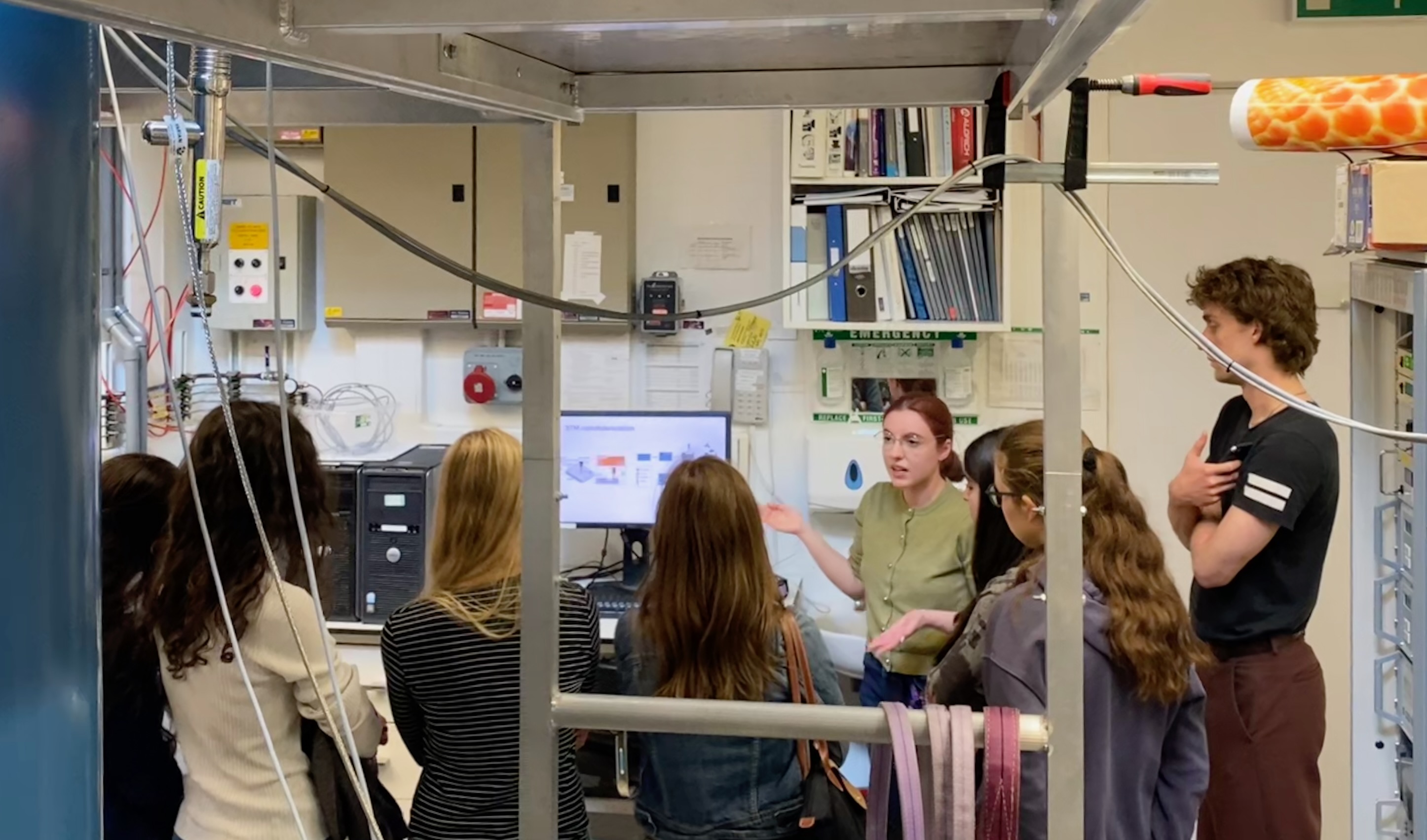
It was a lot for the students to take in one relatively short visit, yet they engaged well when the opportunities to ask questions arose. These ranged from why we use bismuth in silicon to what causes the attraction in chemical bonding. One sharp technical question came from a student who asked how we are able to image individual atoms with our STM in the middle of central London, with the London Underground running nearby. The answer is active noise cancellation: our systems use feedback mechanisms that work similarly in principle to noise-cancelling headphones, but applied to a three-quarter-tonne instrument. There was also lively interest in career pathways in physics research, with both me and the PhD students happy to share our own trajectories.
We very much enjoyed hosting the visit and hope it gave the students a genuine sense of what quantum physics research looks like in practice. After the tours, the students headed off for lunch before making their way back to school for the afternoon.